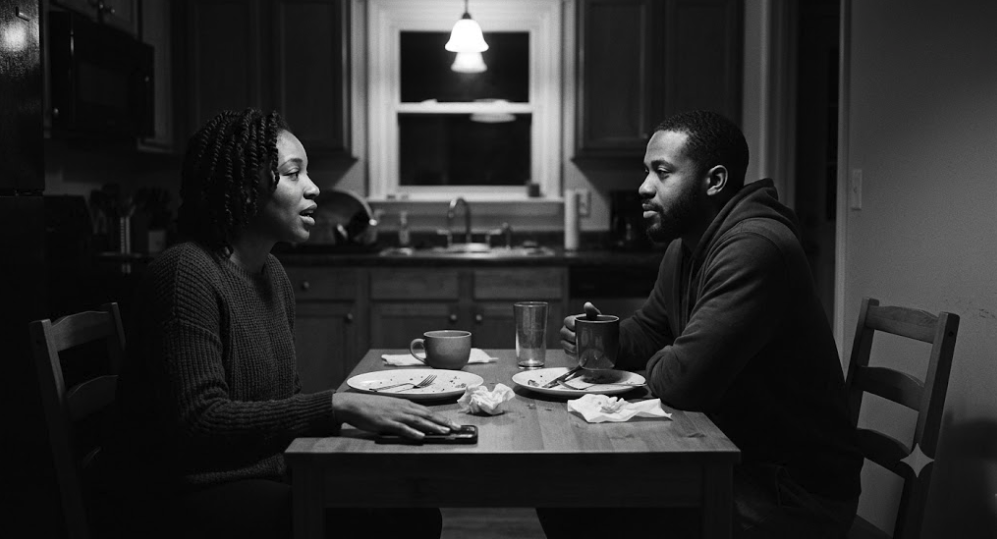
How to Ask Someone Where Their Family Stops and You Start
6 min read · Updated July 2026
Every family pushes on a relationship somehow. Some do it with opinions, some with expectations, some by showing up on a Sunday without calling first. What you need to know early is not whether their family pushes. It's what happens in the hour after.
You have probably already asked the version of this question that doesn't work. What's your family like? People answer that one with adjectives. Close. Loud. Complicated. Far away. Religious. All fine, all useless. None of those words tell you what you actually need, which is what happens to a plan the two of you made after their mother says she doesn't like it.
The family is not the thing you would be living with. The procedure is. Two people can have the same overbearing father and end up in completely different relationships, because one of them repeats what the father said and then decides with their partner what to do, and the other absorbs it, quietly changes the plan, and reports the change as a schedule update.
Nobody says "my family runs my life," so ask about the last time instead
Nobody describes themselves as ruled by their family. Not because people lie on dates, but because that isn't how it feels from the inside. From the inside it feels like keeping the peace, being reasonable, picking your battles, not making a big thing out of nothing. Those are all decent sentences. They can also describe a relationship where your partner's aunt has more influence over your holidays than you do.
So don't ask for a self-assessment. Ask for an event. When did your family last have an opinion about someone you were dating, and what happened? An event has parts you can actually hear: who made the call, what got said, whether the person being discussed ever found out, what changed afterward. People are unreliable narrators about their own character and surprisingly reliable narrators about last November.
You will get one of a few shapes. Someone tells you they shut it down and their family learned not to raise it again. Someone tells you they talked it through with their partner and answered together. Someone tells you they went quiet and it blew over. Someone tells you, honestly, that they folded. All four are usable information. None of them is a grade, and you are not marking a paper.
The two answers that sound identical and aren't
Two answers sound like the same answer and lead to different lives. The first: I hold the line, my partner comes first, and my family knows it. The second: we decide together what to do about it. Both sound partner-first. Both get said warmly, usually with a bit of pride. They are not the same thing.
Holding the line is a defense, and it is usually run by one person. It often means the pressure never reaches you at all. They take the call, they push back, and you never learn that anyone had an opinion about your job or your absence at Easter. That can be a genuine relief. It can also mean decisions about your relationship get made in conversations you are not in, and you find out only after something has been settled on your behalf.
Deciding together is slower and it includes you. It means you hear the unflattering version of what was said, which is uncomfortable, and then you get a say in the reply. Some people want the shield. Some people want the seat at the table and would rather know everything, even the parts that sting. Neither preference is more grown-up than the other. The trouble starts when each of you assumed the other wanted the same one and neither said so out loud.
What you are actually listening for: who gets told first
Here is the most useful thing to listen for, and it is small. Sequencing. When something changes — a trip, a move, a job, a decision about the two of you — who hears about it first?
You can ask that directly and it does not land like an interrogation. When you make a big call, who's the first person you tell? Some people say a sibling. Some say a best friend they've had since school. Some say their mother, and they say it easily, because to them it is simply obvious. That is a real answer about how a life is wired, and it beats any description of a family's temperament.
People who put a partner at the front of that order are not better people. But you learn something specific: whether being with them would mean being in the first conversation or the second one. If you would be in the second one, you want to know that in the first month, not in the week they tell their parents about the move before they tell you it has been decided.
When the honest answer is "there's no system"
Some people will tell you there is no system — whatever's loudest wins. That is the most honest answer available, and it is more common than the tidy ones. It usually means family pressure gets handled case by case, with whoever is most upset that week setting the outcome, and it usually means they have never had a reason to describe the pattern before.
Don't treat that as a problem to solve over one dinner. Ask what it costs them, and let them answer at length. Then say your own version out loud, because you owe them the same clarity you asked for: what you would want to hear about, what you would rather not, what you would need a say in. You are not drafting a policy. You are finding out whether the two of you are describing the same kind of life.
One answer deserves respect rather than alarm: my family's voice carries real weight, and that won't change. Someone who tells you that early is doing you a favor. It is not a warning shot. It is a description of a life with more than two people in it, and the only real question is whether you want that life. Plenty of people do, and are happy in it. The unhappy version is the one where nobody said it until year three.
None of this takes a whole evening. It takes one story about the last time, and one honest sentence about who you would tell first. That is why the MOU asks it directly: when your family pushes into your relationship — opinions, expectations, drop-ins — what actually happens? You both answer that privately before the date, and then you compare what you wrote. It is a much easier conversation when neither of you had to be the one to raise it.