How to Talk About Who Pays Before the Check Ever Lands
6 min read · Updated July 2026
The check does not go wrong because two people want different things. It goes wrong because neither of them says what they want until the moment has already passed, and then the whole night has to be re-read backwards through thirty awkward seconds.
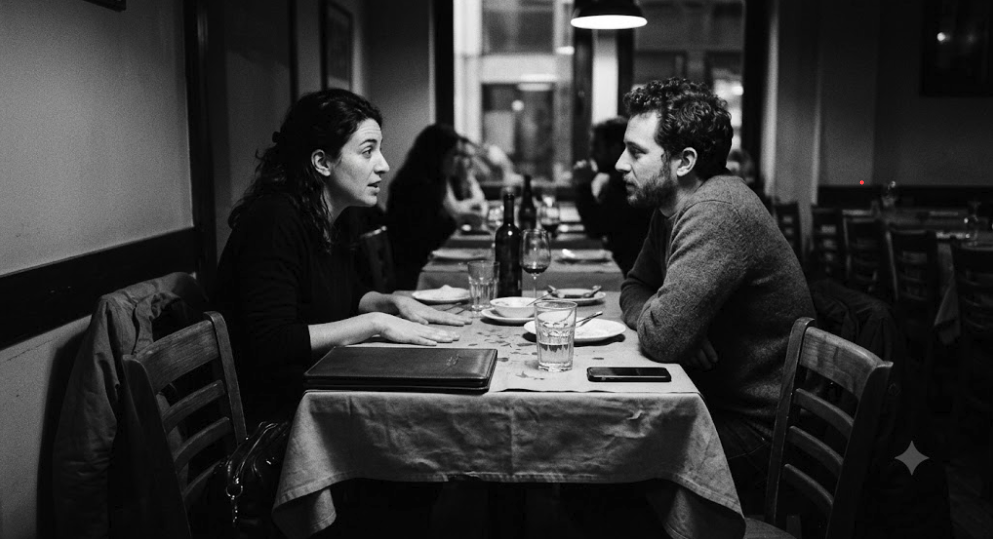
Picture the standard version. The plates are cleared. Someone mentions the folder without mentioning it — a glance, a hand moving toward a bag. One person reaches. The other says "let me get half" in a tone that could mean anything. The first person says "no, I've got it" in a tone that could also mean anything. Money changes hands or it does not, and both people walk to the door replaying it.
Nothing terrible happened. That is the strange part. Nobody was rude, nobody was cheap, nobody made a scene. And yet a good evening now has a smudge on it, because two people improvised through a moment they each had a clear opinion about and neither had said out loud.
Why nobody says anything until it is too late
The check is the first moment on a first date where the two of you have to do something together with real stakes attached. Everything before it is conversation, which is forgiving. The check is a transaction, and transactions are not forgiving. Somebody has to move first.
That is uncomfortable enough on its own. What makes it worse is that everyone brings a whole private theory to the table and assumes it is the obvious one. Some people believe firmly that whoever did the asking pays, and that this has nothing to do with gender and everything to do with who proposed the plan. Some people want to pay because paying is how they show up for someone, and being talked out of it feels like being told their gesture is unwelcome. Some people split every bill of their lives down the middle and find any other arrangement faintly claustrophobic. Some people will offer to split and quietly hope to be overruled. Some people think about it as a series — you get this one, I get the next one — which only works if there is a next one.
All five of those are reasonable. None of them are visible from across a table. So each person sits there running a model of the other person's expectations, built out of nothing, and then acts on the model instead of asking.
The second reason nobody speaks is that money talk feels like it will read as a statement about money. Say "I'd like to pay" and you worry it sounds like a brag, or a claim on the evening. Say "let's split" and you worry it sounds like distance, or a preemptive exit. Say nothing and at least you cannot be misread. That instinct is understandable and it is exactly the thing that produces the smudge.
Say it while you are still making the plan
The fix is boring and it works: move the conversation earlier, into the part where you are still texting about where to go. At that point money is logistics. Nobody is holding a folder. Nobody is watching your face. You can say a whole sentence about it and it costs almost nothing.
Concretely, when you send the place, add your position to it. "I picked it, so it's on me" is one sentence. So is "I'd rather we split, if that's alright with you." So is "Happy to get this one if you get the next." You are not negotiating. You are removing a decision from the end of the evening, where it is expensive, and putting it at the beginning, where it is free.
Say your own position rather than asking theirs first. "What do you usually do about the bill?" hands them the harder job and tells them nothing about you, which is how you end up with two people being polite at each other. Naming yours first gives them something to agree with or adjust, and it gives you information either way. If they say "actually I'd prefer to split," you have learned something real about them before you have ordered a drink, and you have learned it in a low-stakes register.
Keep it short. One line, then move on to what time you are meeting. The longer the message, the more it reads as a thing you are anxious about, and then the other person starts wondering what they are supposed to be anxious about too.
What to do when the folder is already on the table
Most of the time you will not have done any of that, because you are reading this on the day. Fine. There is a version that works from the chair.
Speak before you reach. The reach is the problem — it forces the other person to respond physically, fast, with a hand already in motion. A sentence gives them a beat. "I'd like to get this" or "I'm happy to split this" said plainly, at normal volume, in the tone you have been using all evening, is enough. It is not a grand gesture and it should not sound like one.
Then leave room for their answer instead of steamrolling it. If you say you would like to pay and they say they would genuinely prefer to split, the useful move is to take that at face value once. "Sure, let's do that" costs you nothing and tells them you heard the words rather than the etiquette. Insisting three times past a clear no is not generosity, it is a small demonstration that their stated preference is negotiable, and people notice that on first dates.
And if the other person pays and you had wanted to split, say so at the door rather than swallowing it. "Thank you — next one's mine" is a complete resolution. It accepts the gesture and sets up the balance in eight words.
Offering, insisting, and the gap between them
There is one pattern worth naming because it causes more trouble than any actual disagreement about money: the offer that is not an offer.
Plenty of people reach for their wallet fully expecting to be waved off. The offer is a courtesy, not a proposal. That works fine when both people are running the same script. It fails badly when the other person takes the offer literally, says "great, thanks," and splits the bill — and now one person is quietly stung by something the other person experienced as simple agreement.
You cannot fix that from the outside. You can only be clear about your own version. If you want to pay, say you want to pay rather than performing a struggle over it. If you are offering to split because you actually want to split, let the words carry that. And if you notice that you offer while hoping to be refused, that is worth knowing about yourself before it turns into a grievance you never mentioned.
The point is not that any of these positions is correct. Whoever asked pays, always split, take turns, I want to pay — these are all workable, and two people who want different things here can settle it in one exchange as long as the exchange happens. What does not survive is the silence, because silence gets filled in with guesses, and guesses about money curdle fast.
This is why the MOU asks about the check directly, before the date, as one of the fourteen questions: the folder lands on the table, and what do you honestly believe should happen. You each answer privately, then you see both answers. It is a thirty-second moment that sinks a surprising number of second dates, and answering it in advance means the two of you already know the ending before you sit down. Answer it before the date, and the check goes back to being a piece of paper.